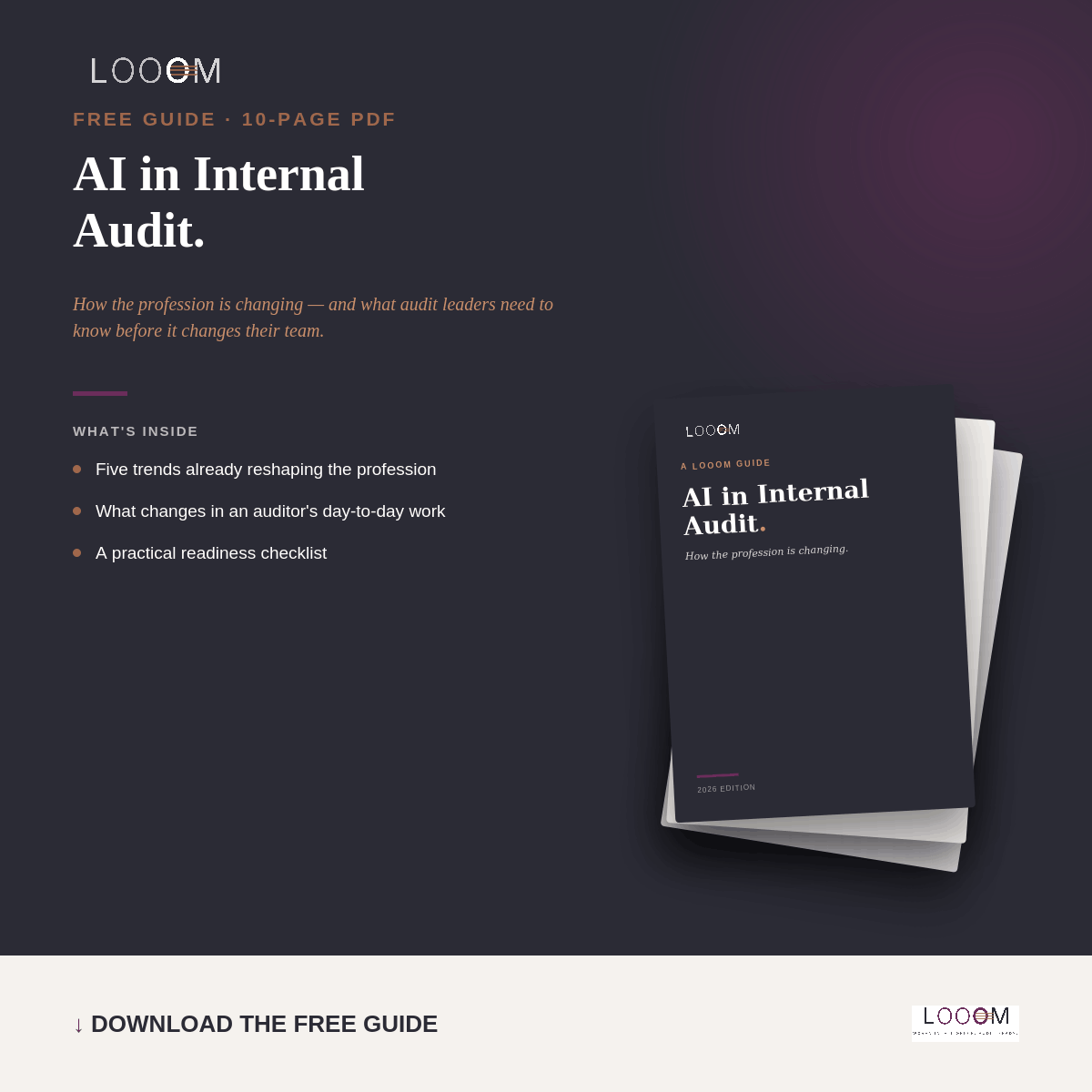
AI in Internal Audit.
How the profession is changing — and what audit leaders need to know before it changes their team.
- Five trends already reshaping the profession
- What changes in an auditor's day-to-day work
- A practical readiness checklist
Most audit functions are still running on a model built for a slower, smaller version of the business they now oversee. Testing happens on a sample because full-population testing by hand was never realistic. Evidence gets gathered and pasted into working papers by people whose real value lies elsewhere.
The gap isn't a talent problem. It's a capacity problem — and it's the reason "do more with the same team" has become the default expectation of every internal audit function, everywhere.
This is the backdrop against which AI is entering the profession. Not as a novelty, but as a response to a capacity problem that was already becoming unsustainable.
Full-population testing
Test every transaction instead of a statistically defensible slice — changing the underlying assurance, not just the speed.
Drafting from evidence
Working papers drafted from uploaded evidence and your firm's knowledge base. The auditor's first draft is already a first draft.
Continuous monitoring
Controls and risk indicators watched on an ongoing basis — issues surface while they're still small.
Reviewing, not authoring
The auditor's role shifts from producing the first version to critically reviewing one — a different skill, and arguably a higher-value one.
What doesn't change: professional scepticism, ethical judgement, and the auditor's accountability for the opinion they sign.
The guide includes a four-part readiness framework covering People (are auditors trained to review AI output critically?), Process (has methodology been revisited for full-population testing?), Technology (do planning, fieldwork, and reporting run in a connected workflow?), and Governance (does someone own the question of where AI output could be wrong?).
Readiness is a People, Process, Technology, and Governance question — not just a software purchase.
Get the Guide
Enter your details below and download the full 10-page PDF instantly.